


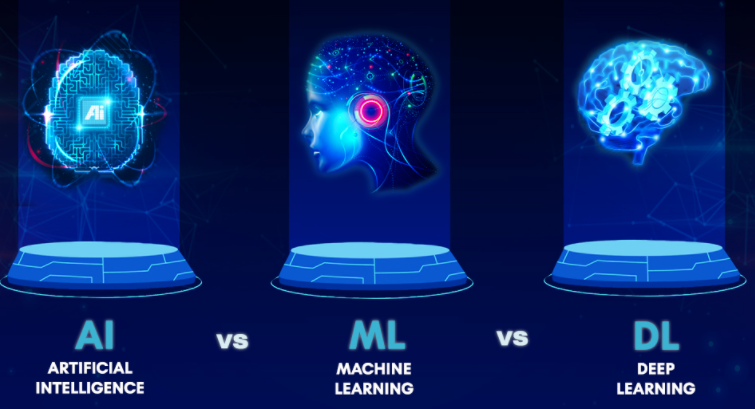
Demystifying AI, Machine Learning, and Deep Learning: Understanding the Core Concepts
AI, Machine Learning, and Deep Learning: Understanding the Differences
In recent years, terms like Artificial Intelligence (AI), Machine Learning (ML), and Deep Learning have become buzzwords in the tech industry. While they are often used interchangeably, they represent different concepts within the field of computer science. This article aims to clarify these terms and explain how they relate to each other.
Artificial Intelligence (AI)
Artificial Intelligence is a broad field of computer science that focuses on creating systems capable of performing tasks that typically require human intelligence. These tasks include problem-solving, understanding natural language, recognizing patterns, and making decisions.
AI can be categorized into two types:
- Narrow AI: This type is designed to perform a specific task or a set of tasks. Examples include virtual assistants like Siri or Alexa and recommendation systems used by Netflix or Amazon.
- General AI: This theoretical form of AI would have the ability to understand or learn any intellectual task that a human can do. It remains largely speculative at this stage.
Machine Learning (ML)
Machine Learning is a subset of AI that involves training algorithms to learn from data and improve their performance over time without being explicitly programmed for each task. ML models identify patterns in data and use them to make predictions or decisions.
The main types of machine learning include:
- Supervised Learning: In this approach, models are trained on labeled datasets, meaning the input data has corresponding output labels. The goal is for the model to learn a mapping from inputs to outputs.
- Unsupervised Learning: Models work with unlabeled data and must find structures or patterns on their own. Clustering algorithms are common in this category.
- Semi-supervised Learning: This combines elements of both supervised and unsupervised learning by using both labeled and unlabeled data for training.
- Reinforcement Learning: Models learn by interacting with an environment through trial and error to maximize some notion of cumulative reward.
Deep Learning
A subset of machine learning, deep learning uses neural networks with many layers (thus “deep”) to analyze various factors of data. Inspired by the structure of the human brain, these neural networks can automatically discover representations from raw data without manual feature extraction.
The most common architectures in deep learning include:
- Convolutional Neural Networks (CNNs): Primarily used for image recognition tasks due to their ability to capture spatial hierarchies in images through convolutional layers.
- Recurrent Neural Networks (RNNs): Designed for sequence prediction problems such as time series analysis or natural language processing due to their ability to maintain memory over sequences.
- Generative Adversarial Networks (GANs): Consist of two networks competing against each other—a generator creates fake samples while a discriminator evaluates them—leading to improved generation quality over time.
The Interconnection Between AI, ML, and DL
The relationship between these fields can be visualized as concentric circles with AI as the largest circle encompassing all intelligent systems. Within it lies machine learning as a subset focused on algorithms that improve through experience. Further within is deep learning—an advanced technique driving many recent breakthroughs in AI applications such as autonomous vehicles or sophisticated language models like GPT-3.
The Future Impact
The advancements in AI technologies continue transforming industries ranging from healthcare diagnostics powered by ML algorithms analyzing medical images accurately; finance sectors leveraging predictive analytics; retail businesses optimizing customer experiences via personalized recommendations; autonomous vehicles navigating complex environments safely—the possibilities seem endless!
The evolution from traditional programming paradigms towards self-learning systems signifies an exciting era where machines assist humans more intuitively than ever before! As research progresses rapidly across academia & industry alike—the potential impact remains boundless!
Mastering AI: 8 Essential Tips for Machine Learning and Deep Learning Success
- Start with a solid understanding of the basics of AI, machine learning, and deep learning.
- Choose the right algorithm based on the type of problem you are trying to solve.
- Collect and preprocess high-quality data to train your models effectively.
- Regularly evaluate and fine-tune your models to improve performance.
- Be mindful of overfitting by using techniques like cross-validation and regularization.
- Stay updated with the latest advancements in AI research and technology.
- Experiment with different architectures and hyperparameters to optimize your models.
- Collaborate with peers in the field to learn from their experiences and insights.
Start with a solid understanding of the basics of AI, machine learning, and deep learning.
To embark on a successful journey into the realms of AI, machine learning, and deep learning, it is crucial to lay a strong foundation by acquiring a comprehensive grasp of the fundamental concepts underlying these technologies. Starting with a solid understanding of the basics not only provides a clear roadmap for further exploration but also ensures a robust knowledge base to build upon as you delve deeper into the intricacies of artificial intelligence and its subsets. By mastering the essentials, you equip yourself with the necessary tools to navigate and comprehend the complexities of AI, machine learning, and deep learning effectively.
Choose the right algorithm based on the type of problem you are trying to solve.
Selecting the appropriate algorithm is crucial when delving into the realms of AI, machine learning, and deep learning. The key to success lies in aligning the algorithm choice with the specific problem at hand. Different algorithms are designed to tackle distinct types of challenges, whether it be classification, regression, clustering, or reinforcement learning. By understanding the nature of your problem and the strengths of various algorithms, you can optimize your approach and enhance the effectiveness of your solution. Remember, a thoughtful selection process paves the way for more accurate predictions and insightful discoveries in the realm of artificial intelligence.
Collect and preprocess high-quality data to train your models effectively.
To maximize the effectiveness of your AI, machine learning, and deep learning models, it is crucial to focus on collecting and preprocessing high-quality data. The quality of your dataset directly impacts the performance and accuracy of your models. By ensuring that your data is clean, relevant, and well-structured before training, you provide a solid foundation for the algorithms to learn from and make informed predictions. Investing time and effort in data collection and preprocessing ultimately leads to more reliable results and unlocks the full potential of your machine learning endeavors.
Regularly evaluate and fine-tune your models to improve performance.
Regularly evaluating and fine-tuning your AI, machine learning, and deep learning models is essential to ensure optimal performance. By continuously assessing their accuracy and efficiency, you can identify areas for improvement and make necessary adjustments to enhance their effectiveness. This iterative process not only helps in maintaining the relevance of your models but also allows them to adapt to evolving data patterns and requirements, ultimately leading to better outcomes and informed decision-making.
Be mindful of overfitting by using techniques like cross-validation and regularization.
When working with AI, machine learning, and deep learning models, it’s crucial to be mindful of overfitting—a scenario where a model learns the training data too well, including its noise and outliers, resulting in poor generalization to new data. To mitigate this risk, techniques like cross-validation and regularization can be employed. Cross-validation involves partitioning the data into subsets to train and validate the model multiple times, ensuring it performs consistently across different data splits. Regularization adds a penalty for larger coefficients in the model’s objective function, discouraging overly complex models that fit the training data too closely. By applying these techniques, one can build models that perform better on unseen data, enhancing their reliability and effectiveness in real-world applications.
Stay updated with the latest advancements in AI research and technology.
To stay ahead in the rapidly evolving fields of AI, machine learning, and deep learning, it is crucial to stay updated with the latest advancements in research and technology. By keeping abreast of new developments, breakthroughs, and best practices, professionals can enhance their knowledge, skills, and expertise to effectively leverage cutting-edge tools and techniques in their projects. Continuous learning and adaptation to emerging trends are key to remaining competitive and innovative in the dynamic landscape of artificial intelligence.
Experiment with different architectures and hyperparameters to optimize your models.
Experimenting with different architectures and hyperparameters is a crucial step in optimizing AI, machine learning, and deep learning models. Each model architecture has its unique strengths and weaknesses, making it essential to test various configurations to find the best fit for a specific problem. Hyperparameters, such as learning rates, batch sizes, and the number of layers or neurons in a neural network, can significantly impact a model’s performance. By systematically adjusting these parameters and evaluating their effects on model accuracy and efficiency, data scientists can fine-tune their models to achieve optimal results. This iterative process not only enhances the model’s predictive capabilities but also provides valuable insights into the underlying data patterns.
Collaborate with peers in the field to learn from their experiences and insights.
Collaborating with peers in the field of AI, machine learning, and deep learning is a valuable strategy to enhance one’s knowledge and skills in these domains. By engaging with fellow professionals, sharing experiences, and exchanging insights, individuals can gain new perspectives, discover innovative approaches, and stay updated on the latest trends and developments. This collaborative environment fosters a culture of continuous learning and growth, ultimately contributing to personal and professional advancement in the rapidly evolving landscape of artificial intelligence technologies.