
cfchris.com

Loading

codingbat java

Mastering Java Programming with CodingBat Challenges

CodingBat Java: Enhance Your Java Programming Skills

CodingBat Java: Enhance Your Java Programming Skills

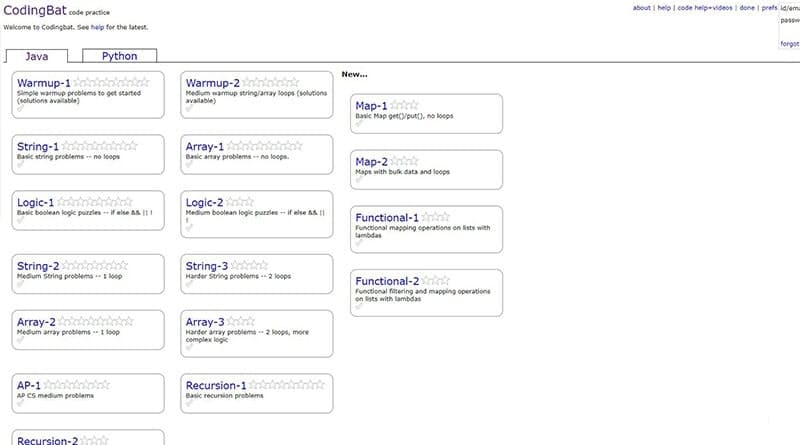
CodingBat is a popular platform that offers a wide range of coding exercises and challenges to help programmers improve their Java skills. Whether you are a beginner looking to learn the basics of Java programming or an experienced developer aiming to enhance your problem-solving abilities, CodingBat has something for everyone.

Features of CodingBat Java

Here are some key features that make CodingBat an excellent resource for Java enthusiasts:

  • Interactive Coding Exercises: CodingBat provides a hands-on learning experience with its interactive coding exercises. You can practice writing Java code directly on the platform and receive instant feedback on your solutions.
  • Varied Difficulty Levels: From simple warm-up exercises to more complex challenges, CodingBat offers coding problems of varying difficulty levels. This allows you to gradually progress and strengthen your Java programming skills.
  • Focus on Problem-Solving: The exercises on CodingBat are designed to test your problem-solving abilities and logical thinking. By tackling these challenges, you can sharpen your coding techniques and become a more efficient programmer.
  • Immediate Feedback: One of the highlights of CodingBat is its immediate feedback system. As soon as you submit your solution, the platform evaluates it and provides feedback on whether it is correct or incorrect. This real-time feedback helps you learn from your mistakes and improve your coding proficiency.

How to Get Started with CodingBat Java

If you’re ready to dive into the world of Java programming with CodingBat, follow these simple steps to get started:

  1. Create an account on the CodingBat website.
  2. Select the “Java” section to access the collection of Java coding exercises.
  3. Choose an exercise that interests you and start working on solving it using Java code.
  4. Submit your solution and review the feedback provided by CodingBat.
  5. Continue practicing with more exercises to hone your skills and expand your knowledge of Java programming.

CodingBat is not just a platform for practicing coding; it is a community where programmers can learn from each other, share insights, and grow together. Join CodingBat today and take your Java programming skills to new heights!


8 Essential Tips for Mastering Java on CodingBat

  1. Start with the warm-up exercises to build your confidence and understanding of basic Java concepts.
  2. Read the problem statement carefully before attempting to solve it.
  3. Break down the problem into smaller, manageable tasks to make it easier to solve.
  4. Test your code with different inputs to ensure that it works correctly in all scenarios.
  5. Don’t hesitate to look at the provided solutions if you get stuck, but try to understand them before moving on.
  6. Use meaningful variable names and comments to make your code more readable and maintainable.
  7. Practice regularly on CodingBat to improve your coding skills and speed.
  8. Help others in the CodingBat community by providing clear explanations for your solutions.

Start with the warm-up exercises to build your confidence and understanding of basic Java concepts.

To enhance your Java programming skills on CodingBat, it is advisable to begin with the warm-up exercises. These introductory challenges serve as a solid foundation, helping you build confidence and grasp fundamental Java concepts. By starting with the warm-up exercises, you can gradually familiarize yourself with essential programming techniques and boost your understanding of Java basics. This approach sets a strong groundwork for tackling more complex coding problems effectively and efficiently.

Read the problem statement carefully before attempting to solve it.

To maximize your success on CodingBat Java, it is crucial to read the problem statement carefully before diving into solving it. Understanding the requirements and constraints outlined in the problem statement ensures that you approach the coding exercise with clarity and precision. By taking the time to comprehend the problem thoroughly, you can effectively strategize your solution and avoid potential misunderstandings that may lead to errors. Remember, a solid grasp of the problem statement is the foundation for crafting accurate and efficient code solutions on CodingBat.

Break down the problem into smaller, manageable tasks to make it easier to solve.

Breaking down the problem into smaller, manageable tasks is a valuable tip when working on coding exercises in Java on CodingBat. By dividing the problem into smaller components, programmers can tackle each task individually, making the overall problem-solving process more approachable and less overwhelming. This approach allows for a more systematic and organized way of addressing complex challenges, leading to more efficient and effective solutions. Breaking down the problem helps programmers focus on one aspect at a time, leading to clearer logic and better code structure in their Java solutions.

Test your code with different inputs to ensure that it works correctly in all scenarios.

It is essential to test your Java code with various inputs to verify its functionality across different scenarios. By testing your code with a range of inputs, you can ensure that it behaves correctly under diverse conditions and edge cases. This practice helps identify and address potential bugs or errors, ultimately leading to more robust and reliable Java programs. Testing with different inputs is a crucial step in the development process to enhance the quality and performance of your code.

Don’t hesitate to look at the provided solutions if you get stuck, but try to understand them before moving on.

When tackling coding exercises on CodingBat Java, it is advisable not to hesitate to refer to the provided solutions if you encounter difficulties. However, it is essential to take the time to comprehend these solutions thoroughly before progressing further. By understanding the provided solutions, you not only overcome the immediate challenge but also gain valuable insights into different problem-solving approaches and coding techniques. This practice enhances your learning experience and equips you with a deeper understanding of Java programming concepts.

Use meaningful variable names and comments to make your code more readable and maintainable.

Using meaningful variable names and adding comments to your code on CodingBat Java can significantly enhance its readability and maintainability. By choosing descriptive names for your variables, functions, and classes, you make it easier for yourself and others to understand the purpose of each component in your code. Additionally, incorporating comments to explain complex logic or provide context can help future developers navigate through the codebase with ease. These practices not only improve the clarity of your code but also contribute to its long-term sustainability and scalability.

Practice regularly on CodingBat to improve your coding skills and speed.

Regular practice on CodingBat is key to enhancing your coding skills and increasing your coding speed in Java. By consistently working on the coding exercises provided on the platform, you can sharpen your problem-solving abilities, familiarize yourself with various Java concepts, and develop a quicker and more efficient coding style. The more you practice, the more confident and proficient you will become in writing Java code, ultimately paving the way for greater success in your programming endeavors.

Help others in the CodingBat community by providing clear explanations for your solutions.

In the CodingBat Java community, it is essential to help others by offering clear explanations for your solutions. By providing detailed insights into your coding approach and reasoning behind your solutions, you not only assist fellow programmers in understanding complex problems but also contribute to a collaborative learning environment. Clear explanations not only showcase your problem-solving skills but also foster a sense of community where knowledge sharing and mutual support are valued. Embracing this practice on CodingBat can lead to meaningful interactions, improved coding proficiency, and a stronger sense of camaraderie among members of the community.

10x programmer

Debunking the Myth of the 10x Programmer: The Truth Behind Software Development Productivity

The Myth of the 10x Programmer

The Myth of the 10x Programmer

There’s a popular concept in the software development industry that some programmers are “10x programmers” – individuals who are ten times more productive than their peers. This idea has sparked debates and discussions among developers and tech enthusiasts.

While it’s tempting to believe in the existence of such superhuman programmers, the reality is often more nuanced. Productivity in software development is influenced by a variety of factors, including experience, collaboration, tools, and project complexity.

Research has shown that individual productivity variations among programmers are not as extreme as the 10x myth suggests. Instead, high-performing teams with diverse skill sets tend to deliver better results collectively than relying on a single “rockstar” developer.

Furthermore, the emphasis on individual productivity can overshadow the importance of teamwork, communication, and shared goals in software projects. Collaboration and knowledge sharing within a team often lead to more sustainable and successful outcomes.

It’s essential for organizations to foster environments that promote teamwork, continuous learning, and mutual support among team members. Building a culture of collaboration and inclusivity can enhance overall productivity and innovation within a development team.

In conclusion, while the idea of a 10x programmer may be appealing, it’s crucial to recognize that successful software development is a team effort. By valuing collaboration, diversity of thought, and continuous improvement, organizations can achieve greater success in delivering quality software products.


Understanding the 10x Programmer: Existence, Traits, and Impact on Software Development Teams

  1. What is a 10x programmer?
  2. Do 10x programmers really exist?
  3. How can I become a 10x programmer?
  4. What are the characteristics of a 10x programmer?
  5. Is the concept of a 10x programmer beneficial for software development teams?

What is a 10x programmer?

A 10x programmer is a term used to describe an individual who is believed to be exceptionally more productive than the average programmer, potentially delivering ten times the output. This concept suggests that certain developers possess unique skills, efficiency, and expertise that enable them to work significantly faster and produce higher-quality code compared to their peers. While the idea of a 10x programmer has gained attention in the software development industry, there is ongoing debate about the validity and practical implications of such a designation.

Do 10x programmers really exist?

The question of whether 10x programmers truly exist is a common topic of discussion in the software development community. While the concept of individuals who are ten times more productive than their peers is intriguing, empirical evidence suggests that such extreme productivity differences are rare. Productivity in programming is influenced by various factors, including experience, collaboration, and project complexity. Rather than focusing on individual performance metrics, emphasizing teamwork, knowledge sharing, and a supportive work environment can lead to more sustainable and successful outcomes in software development projects. Ultimately, while exceptional programmers certainly exist, the collective effort of a high-performing team often yields the best results in the long run.

How can I become a 10x programmer?

Becoming a “10x programmer” is a common aspiration among many in the software development community. While the idea of achieving exceptional productivity and efficiency is appealing, it’s important to remember that there is no one-size-fits-all formula for becoming a 10x programmer. Instead of focusing solely on individual performance metrics, aspiring developers can benefit from honing their technical skills, cultivating a growth mindset, and actively seeking opportunities for learning and collaboration. Embracing continuous improvement, staying curious, and staying open to feedback are key attributes that can contribute to personal and professional growth in the field of software development. Ultimately, becoming a highly effective programmer involves dedication, persistence, and a willingness to adapt to new challenges and technologies as they arise.

What are the characteristics of a 10x programmer?

When discussing the characteristics of a 10x programmer, several traits are often highlighted. These individuals are known for their exceptional problem-solving skills, deep technical expertise, efficiency in coding, and ability to quickly grasp complex concepts. They are proactive in seeking out solutions, highly motivated, and continuously strive to improve their skills. Communication skills are also crucial for a 10x programmer, as they need to effectively collaborate with team members and stakeholders. Additionally, a strong work ethic, creativity in finding innovative solutions, and a passion for learning and staying updated with the latest technologies are commonly associated with these high-performing developers.

Is the concept of a 10x programmer beneficial for software development teams?

The concept of a 10x programmer, referring to individuals who are exceptionally more productive than their peers, is a topic of debate within the software development community. While the idea of having such high-performing individuals on a team may seem beneficial at first glance, it is important to consider the potential drawbacks. Focusing solely on individual productivity can undermine the value of teamwork, collaboration, and shared responsibility in software development projects. Emphasizing team dynamics and creating an environment that encourages knowledge sharing and collective problem-solving often leads to more sustainable and successful outcomes for software development teams. Ultimately, striking a balance between recognizing individual contributions and fostering a collaborative team culture is key to achieving long-term success in software development.

open source software development

Exploring the Impact of Open Source Software Development

Article: Open Source Software Development

The Power of Open Source Software Development

Open source software development has revolutionized the way we create and use technology. Unlike proprietary software, open source software is built collaboratively by a community of developers who openly share their code and contribute to its improvement.

One of the key benefits of open source software is its transparency. Anyone can access the source code, modify it, and distribute it freely. This fosters innovation and allows for rapid development cycles as developers around the world can collectively work on enhancing the software.

Moreover, open source software promotes inclusivity and diversity in the tech industry. Developers from different backgrounds and skill levels can participate in projects, learn from each other, and build a more inclusive community.

Key Principles of Open Source Software Development:

  • Collaboration: Developers work together to create and improve software.
  • Transparency: The source code is accessible to all, promoting trust and accountability.
  • Innovation: Rapid iteration and feedback lead to innovative solutions.
  • Inclusivity: Open source projects welcome contributions from diverse communities.
  • Community: A sense of belonging and shared purpose drives open source development.

In recent years, many successful projects have emerged from the open source community, including popular web browsers like Mozilla Firefox, operating systems like Linux, and programming languages like Python. These projects have not only gained widespread adoption but have also influenced proprietary software development practices.

As we look to the future of technology, open source software development continues to play a crucial role in driving innovation, collaboration, and accessibility in the digital landscape. By embracing the principles of openness and community-driven development, we can create a more sustainable and inclusive tech ecosystem for generations to come.


Understanding Open Source Software Development: Key FAQs

  1. What is meant by open source development?
  2. What are examples of open source software?
  3. What are open source development tools?
  4. How is open source software developed?
  5. How do I become an open source software developer?
  6. Does open source software have a developer?
  7. What software is built on open source?

What is meant by open source development?

Open source development refers to the collaborative process of creating software where the source code is made freely available to the public. In open source development, programmers from around the world can view, modify, and distribute the code, fostering a community-driven approach to software creation. This model promotes transparency, innovation, and inclusivity by allowing developers of varying backgrounds to contribute to projects and improve the software collectively. Open source development has revolutionized the tech industry by democratizing access to technology and encouraging a culture of sharing and collaboration among developers.

What are examples of open source software?

Open source software encompasses a wide range of applications across various domains. Some prominent examples of open source software include the Linux operating system, which powers a significant portion of servers and embedded devices worldwide. Additionally, popular web browsers like Mozilla Firefox and Chromium are open source projects that prioritize user privacy and customization. Development tools such as the Apache web server, MySQL database management system, and the programming language Python are also well-known examples of open source software that have gained widespread adoption in the tech industry. These examples highlight the diversity and impact of open source software in enabling innovation and collaboration within the global developer community.

What are open source development tools?

Open source development tools are software applications specifically designed to support and streamline the process of creating open source projects. These tools encompass a wide range of functionalities, including code editors, version control systems, build automation tools, testing frameworks, and project management platforms. By utilizing open source development tools, developers can collaborate more efficiently, track changes in the codebase, automate repetitive tasks, ensure code quality through testing, and manage project timelines effectively. These tools not only enhance productivity but also promote transparency and accessibility in the development process by enabling contributors to work together seamlessly on open source projects.

How is open source software developed?

Open source software development follows a collaborative and transparent process where developers from around the world contribute to creating and improving software. Typically, an open source project starts with an idea or a need identified by an individual or a group of developers. The source code is made available to the public, allowing anyone to view, modify, and enhance it. Developers can collaborate through online platforms like GitHub, where they can submit code changes, report issues, and discuss improvements with the community. This iterative process of feedback, contribution, and review results in the continuous development of open source software that is accessible to all and benefits from diverse perspectives and expertise.

How do I become an open source software developer?

To become an open source software developer, one can start by selecting a project that aligns with their interests and skills. Engaging with the open source community through forums, mailing lists, and code repositories can provide valuable insights and networking opportunities. Contributing to projects by fixing bugs, adding new features, or improving documentation is a great way to gain experience and build a reputation within the community. Continuous learning and collaboration with other developers are key aspects of becoming a successful open source software developer.

Does open source software have a developer?

In the realm of open source software development, the question of whether open source software has a developer is a common inquiry. Unlike proprietary software where a single entity typically owns and controls the development process, open source software projects often have multiple developers contributing to the codebase. These developers can come from diverse backgrounds and may collaborate on the project voluntarily or as part of a community effort. The decentralized nature of open source development allows for greater innovation, transparency, and inclusivity as developers work together to enhance and maintain the software for the benefit of all users.

What software is built on open source?

Many popular software applications are built on open source technologies. Examples include web browsers like Mozilla Firefox and Google Chrome, operating systems such as Linux distributions like Ubuntu and Fedora, content management systems like WordPress and Joomla, programming languages like Python and PHP, and development tools like Git and Apache. These software products leverage the collaborative efforts of the open source community to deliver reliable, secure, and innovative solutions to users worldwide. By utilizing open source components, developers can benefit from a wealth of resources and expertise while contributing to the advancement of technology in a transparent and inclusive manner.