
cfchris.com

Loading

erp development

ERP Development: A Practical Guide to Building a System That Fits Your Business

ERP Development: Building a System Around the Way Your Business Works

Enterprise resource planning (ERP) development is the process of creating or customizing software that connects a company’s core operations in one system. Instead of relying on separate tools for accounting, inventory, sales, purchasing, and human resources, an ERP system brings key data and workflows together.

For many organizations, the goal is not simply to install new software. It is to make everyday work more consistent, improve visibility across departments, and give employees reliable information for making decisions. A thoughtfully developed ERP system can support those goals while adapting to the organization’s processes and future plans.

What Is ERP Development?

ERP development can include building a new system, extending an existing ERP platform, or integrating ERP software with other business applications. The right approach depends on the organization’s needs, budget, technical environment, and willingness to adapt its processes.

An ERP solution may connect functions such as:

  • Finance, billing, and accounting
  • Inventory and warehouse management
  • Purchasing and supplier management
  • Sales, customer service, and order processing
  • Manufacturing and production planning
  • Human resources and payroll
  • Reporting and business analytics

Not every business needs all of these capabilities. ERP development is most effective when the system is designed around the processes and information the organization actually needs.

Custom ERP Development or an Existing Platform?

Businesses typically choose between customizing an established ERP platform and developing a solution from the ground up. Neither option is right for every organization.

Customizing an Existing ERP

An established platform may offer proven features, regular updates, and a broad ecosystem of support. Customization can fill gaps in the standard product or connect it to specialized tools. This approach may reduce development time, but extensive modifications can make upgrades and maintenance more complicated.

Building a Custom ERP System

A custom system can be designed for distinctive workflows, industry requirements, or legacy environments. It may provide greater control over features and user experience. However, custom development requires careful planning and ongoing investment in security, support, hosting, and future enhancements.

Before choosing, compare the cost and flexibility of each option over its full lifecycle—not just the initial implementation. A platform that seems inexpensive at first may require costly customization, while a custom system may take longer to build and maintain.

Key Benefits of ERP Development

More Consistent Information

When departments work from separate spreadsheets and applications, information can become duplicated or out of date. An ERP system can create a shared source of information, helping teams coordinate around consistent records and processes.

Improved Operational Visibility

Integrated data can help managers understand what is happening across the business. For example, connecting sales, purchasing, and inventory information can make it easier to spot supply concerns or track orders.

Streamlined Workflows

ERP software can reduce repetitive data entry and automate routine steps, such as approval routing, notifications, and invoice processing. Automation should be introduced carefully: unclear or inefficient processes should be improved before they are built into software.

Better Reporting

With data organized across business functions, teams can create more useful reports and monitor performance. The value depends on accurate data, well-defined metrics, and reporting tools that answer real business questions.

Support for Growth

A well-planned ERP system can accommodate new locations, products, users, or workflows. Scalability requires more than adding server capacity; the system’s architecture and data model must also support change.

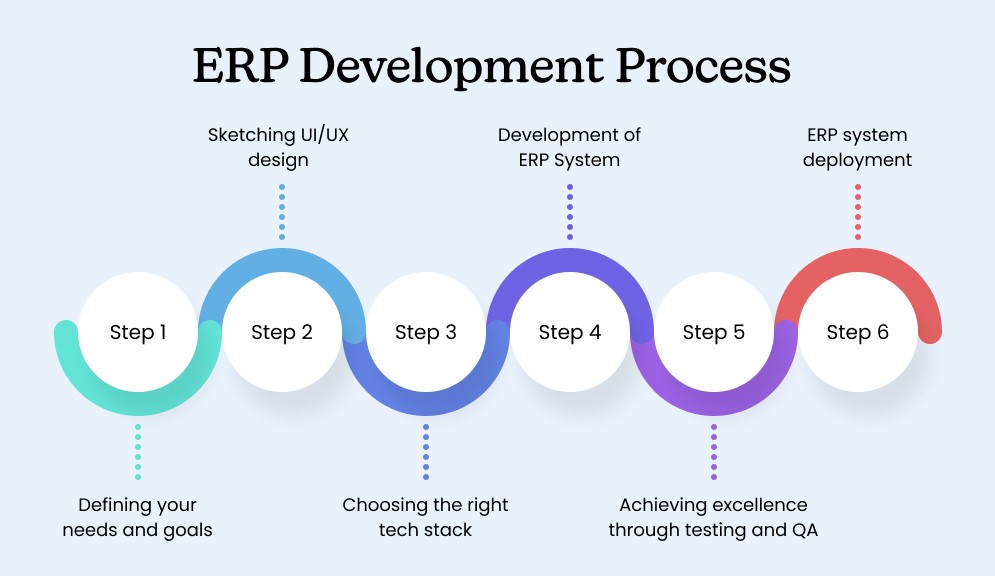
The ERP Development Process

Define Business Goals

Start by identifying the problems the system should solve. Goals might include reducing order processing time, improving inventory accuracy, or consolidating financial reporting. Clear outcomes help guide decisions and make it possible to evaluate the project.

Map Existing Processes

Document how work currently moves through the organization, including exceptions and manual workarounds. Involve employees who perform these tasks every day. Their feedback can reveal requirements that may not be visible to leadership or technical teams.

Set Requirements and Priorities

Separate essential requirements from features that can wait. Consider user roles, workflows, reports, integrations, regulatory needs, and data migration. A prioritized list helps control scope and focus the initial release on the most important capabilities.

Choose the Architecture and Technology

Decide whether the system will be cloud-based, hosted on company infrastructure, or use a hybrid approach. The choice affects access, performance, security, maintenance, and cost. Technical decisions should reflect the organization’s capabilities and long-term needs.

Design and Build in Stages

Developers and stakeholders can work together to create the system in manageable releases. Prototypes and frequent reviews make it easier to identify usability issues and adjust requirements before they become expensive to change.

Migrate and Validate Data

Data migration is one of the most important parts of an ERP project. Before transferring information, teams should identify duplicate, incomplete, or outdated records. Test migrations and reconciliation checks can help confirm that important data arrives accurately.

Test, Train, and Launch

Testing should cover individual features, integrations, security, performance, and complete business workflows. Training should be practical and role-specific, giving employees a chance to learn the tasks they will perform. A phased rollout may reduce disruption compared with launching every feature at once.

Maintain and Improve

After launch, the system needs monitoring, support, security updates, and a process for handling user feedback. Reviewing performance against the original goals can help determine which improvements should come next.

Important Considerations

  • Scope: Trying to replace every system and automate every process at once can increase risk. Prioritize the most valuable capabilities.
  • Integration: ERP software may need to exchange information with payment services, ecommerce platforms, shipping providers, or older applications. Plan how data will move and how errors will be handled.
  • Security: Use appropriate access controls, encryption, backups, and audit logs. Employees should only be able to view or change information needed for their roles.
  • Data quality: Poor-quality data can undermine reporting and automation. Establish ownership and rules for maintaining important records.
  • User adoption: A technically capable system can still fail if it is difficult to use or does not fit employees’ workflows. Include users throughout design, testing, and training.
  • Total cost: Account for implementation, licensing, development, data migration, training, hosting, support, and future upgrades.

Common ERP Development Challenges

ERP projects can become difficult when requirements are unclear, stakeholders are not involved, or customization grows without strong controls. Delayed decisions and underestimated data-cleanup work can also affect timelines and budgets.

These challenges can be reduced by assigning clear project ownership, agreeing on priorities, reviewing progress regularly, and making decisions based on business value. It is also important to plan for change management: new software often changes responsibilities and routines, not just screens and reports.

How to Measure ERP Success

Success should be measured against the goals established before development begins. Useful indicators may include:

  • Time required to complete key workflows
  • Inventory accuracy and order fulfillment performance
  • Rate of manual data entry or duplicate records
  • Reporting speed and data consistency
  • System availability and support requests
  • Employee adoption and user satisfaction

These measures should be reviewed over time. An ERP system is an ongoing business tool, and its value depends on how well it continues to support changing needs.

Conclusion

ERP development can help an organization connect its operations, improve access to business information, and create more consistent workflows. The best solution is not necessarily the largest or most customized one. It is the system that addresses clear business needs, fits the organization’s capabilities, and can be maintained as the business evolves.

By setting practical goals, involving employees, planning data and integrations carefully, and delivering the system in stages, organizations can make ERP development a more manageable and valuable investment.


9 ERP Development Tips for a Successful Implementation

  1. Map business processes before designing modules.
  2. Involve end users early and often.
  3. Keep customizations minimal and well documented.
  4. Prioritize data quality before migration.
  5. Plan integrations and APIs from the start.
  6. Build security into every workflow.
  7. Test edge cases and peak workloads.
  8. Train users with role-specific examples.
  9. Monitor performance and refine after launch.

Map business processes before designing modules.

Before designing ERP modules, map how work moves through your business—from the first request to the final outcome. Document each step, the people involved, the information required, and any exceptions or manual workarounds. This helps ensure the system reflects real operational needs rather than assumptions, reveals opportunities to simplify workflows, and prevents costly redesign later. Involve employees who perform the work every day so the finished modules are practical and easy to use.

Involve end users early and often.

Involving end users early and often helps ensure an ERP system reflects how work actually gets done. Employees who use the system every day can identify practical requirements, common bottlenecks, and potential usability problems that might otherwise be overlooked. Gather their input during planning, share prototypes for feedback, and include them in testing before launch. Ongoing communication and role-specific training can also build trust, encourage adoption, and reduce costly changes later in development.

Keep customizations minimal and well documented.

Keep ERP customizations to a minimum and document every change clearly. Excessive modifications can make upgrades, troubleshooting, and ongoing support more difficult, while undocumented changes may leave teams unsure how the system works. Whenever possible, use the platform’s standard features and configuration options, and record the purpose, owner, and impact of each customization so it can be reviewed and maintained over time.

Prioritize data quality before migration.

Prioritize data quality before migrating information into a new ERP system. Review existing records for duplicates, missing fields, outdated details, and inconsistent formats, then clean and standardize the data before transfer. Assign clear ownership for important records and test the migration with a sample set to verify accuracy. Starting with reliable data helps prevent errors in reports, workflows, and business decisions after launch.

Plan integrations and APIs from the start.

Plan integrations and APIs from the start of ERP development, not as an afterthought. Identify which systems need to exchange data—such as accounting tools, ecommerce platforms, payment services, or warehouse software—and define how that information will flow. Clear API standards, data formats, authentication, and error handling help ensure integrations are reliable and secure. Planning early can also prevent costly rework and make it easier to add or replace systems as business needs change.

Build security into every workflow.

Build security into every ERP workflow from the start, rather than treating it as a final check. Define role-based access so employees can view and change only the information they need, and protect sensitive actions with approval steps, validation, and audit logs. Secure data as it moves between the ERP and connected systems, and regularly review permissions as roles change. Making these safeguards part of everyday processes helps reduce errors, prevent unauthorized access, and protect business information without creating unnecessary friction for users.

Test edge cases and peak workloads.

Test edge cases and peak workloads before launching your ERP system. Check how it handles unusual inputs, missing or duplicate data, failed integrations, and unexpected user actions—not just routine workflows. Then simulate busy periods, such as month-end processing or a surge in orders, to uncover slowdowns and capacity limits. Finding these issues early helps protect data accuracy, maintain reliable performance, and prevent costly disruptions when the system is in everyday use.

Train users with role-specific examples.

Train users with role-specific examples so they can see how the ERP system supports the tasks they perform every day. Instead of giving every employee the same broad overview, tailor training to each team’s workflows—for example, show warehouse staff how to receive inventory, while finance staff practice reviewing invoices and reconciling payments. Hands-on, familiar scenarios make new features easier to understand, build confidence, and help users avoid mistakes when the system goes live.

Monitor performance and refine after launch.

After your ERP system launches, monitor its performance to make sure it’s meeting business goals and supporting day-to-day work. Track indicators such as system response times, workflow completion rates, data accuracy, and user feedback. Regularly review the results with employees and stakeholders, then prioritize improvements based on the issues and opportunities you uncover. Ongoing refinement helps keep the system reliable, useful, and aligned with changing business needs.


erp software development company
erp

Empowering Business Excellence: The Role of an ERP Software Development Company

ERP Software Development Company: Revolutionizing Business Operations

ERP Software Development Company: Revolutionizing Business Operations

In today’s fast-paced business environment, organizations are constantly seeking ways to streamline their operations, improve efficiency, and enhance productivity. This is where Enterprise Resource Planning (ERP) software comes into play. An ERP software development company plays a crucial role in helping businesses integrate and automate their core processes.

ERP software is designed to centralize data and processes across various departments within an organization, providing a unified platform for managing resources, enhancing collaboration, and making informed decisions. With the help of an ERP system tailored to their specific needs, companies can optimize their workflows, reduce manual tasks, and gain real-time insights into their operations.

The Role of an ERP Software Development Company

An ERP software development company specializes in creating customized ERP solutions that align with the unique requirements of each client. These companies employ skilled developers, analysts, and project managers who work closely with businesses to understand their processes and design a system that addresses their pain points.

From initial consultation to implementation and ongoing support, an ERP software development company guides organizations through every stage of the ERP software development lifecycle. They ensure that the solution is scalable, user-friendly, and seamlessly integrated with existing systems.

Benefits of Working with an ERP Software Development Company

Collaborating with an ERP software development company offers several advantages for businesses:

  • Customization: Tailored ERP solutions that meet specific business needs.
  • Efficiency: Streamlined processes and automated workflows for increased productivity.
  • Scalability: Solutions that can grow with the business and adapt to changing requirements.
  • Data Insights: Real-time analytics and reporting capabilities for better decision-making.
  • Sustainability: Ongoing support and maintenance to ensure optimal performance.

In Conclusion

An ERP software development company plays a vital role in helping businesses leverage technology to optimize their operations and drive growth. By partnering with a trusted provider of custom ERP solutions, organizations can unlock new opportunities for efficiency, innovation, and success in today’s competitive landscape.


6 Essential Tips for Developing Effective ERP Software Solutions

  1. Understand the specific needs and requirements of clients before starting development.
  2. Ensure the ERP software is scalable to accommodate future growth and changes.
  3. Implement robust security measures to protect sensitive business data.
  4. Regularly update and maintain the ERP software to keep it efficient and secure.
  5. Provide comprehensive training and support for clients to maximize user adoption.
  6. Collaborate closely with clients throughout the development process to ensure alignment with their goals.

Understand the specific needs and requirements of clients before starting development.

To ensure the success of ERP software development projects, it is essential for an ERP software development company to thoroughly understand the specific needs and requirements of their clients before initiating the development process. By taking the time to gather comprehensive insights into the client’s business processes, challenges, and goals, the development team can tailor a customized ERP solution that perfectly aligns with the client’s objectives. This client-centric approach not only enhances the effectiveness of the ERP system but also fosters a collaborative partnership that leads to long-term success and satisfaction for both parties involved.

Ensure the ERP software is scalable to accommodate future growth and changes.

It is essential for an ERP software development company to ensure that the ERP solution they create is scalable to accommodate future growth and changes within an organization. By designing a scalable system, businesses can easily expand their operations, add new functionalities, and adapt to evolving business requirements without the need for a complete system overhaul. Scalability in ERP software allows companies to stay agile and competitive in a dynamic business environment, enabling them to leverage technology as a strategic asset for long-term success.

Implement robust security measures to protect sensitive business data.

It is crucial for an ERP software development company to implement robust security measures to safeguard sensitive business data. By prioritizing data protection, such as encryption, access controls, and regular security audits, the company can mitigate the risk of cyber threats and unauthorized access. Ensuring the confidentiality, integrity, and availability of data not only builds trust with clients but also demonstrates a commitment to maintaining a secure environment for critical business information.

Regularly update and maintain the ERP software to keep it efficient and secure.

Regularly updating and maintaining your ERP software is essential to ensure its efficiency and security. By staying current with software updates, you can benefit from improved performance, new features, and bug fixes that enhance the overall functionality of the system. Additionally, keeping your ERP software up-to-date helps protect against potential security vulnerabilities, ensuring that your sensitive business data remains safe and secure. Prioritizing regular maintenance and updates for your ERP software is key to maximizing its effectiveness and safeguarding your business operations.

Provide comprehensive training and support for clients to maximize user adoption.

To maximize user adoption of ERP software developed by a company, it is crucial to provide comprehensive training and support for clients. By offering thorough training sessions and ongoing support, businesses can ensure that users understand the system’s functionalities and benefits. This proactive approach not only boosts user confidence but also enhances overall productivity and efficiency within the organization. Investing in training and support demonstrates a commitment to customer success and helps clients fully harness the power of their ERP solution for long-term success.

Collaborate closely with clients throughout the development process to ensure alignment with their goals.

Collaborating closely with clients throughout the ERP software development process is essential to ensure alignment with their goals and objectives. By maintaining open communication and involving clients in key decision-making stages, an ERP software development company can tailor the solution to meet the specific needs of the business. This collaborative approach not only fosters a deeper understanding of the client’s requirements but also builds trust and ensures that the final product aligns seamlessly with their strategic vision, ultimately leading to a successful implementation and long-term satisfaction.

erp software development services
erp

Empowering Businesses with Custom ERP Software Development Services

ERP Software Development Services

The Importance of ERP Software Development Services for Businesses

Enterprise Resource Planning (ERP) software plays a crucial role in streamlining and integrating various business processes within an organization. As businesses evolve and grow, the need for customized ERP solutions becomes increasingly essential to meet specific requirements and enhance operational efficiency.

Benefits of ERP Software Development Services

Customization: One of the primary advantages of ERP software development services is the ability to tailor the system to fit the unique needs of a business. Customized ERP solutions can automate workflows, improve data accuracy, and provide real-time insights for better decision-making.

Scalability: As businesses expand, their operational requirements change. With custom ERP software development services, organizations can easily scale their systems to accommodate growth without disrupting existing processes.

Integration: ERP software development services enable seamless integration with other applications and systems used within an organization. This integration enhances data flow across departments and eliminates silos, leading to improved collaboration and productivity.

Key Features of Custom ERP Solutions

Modules for Different Functions: Custom ERP solutions can be designed with modules tailored to specific functions such as finance, human resources, inventory management, customer relationship management (CRM), and more.

Reporting and Analytics: Advanced reporting and analytics capabilities allow businesses to generate custom reports, track key performance indicators (KPIs), and gain valuable insights into their operations for informed decision-making.

Mobile Accessibility: With the increasing trend of remote work, mobile accessibility has become a crucial feature in custom ERP solutions. Employees can access important data and perform tasks on-the-go using mobile devices.

Choosing the Right ERP Software Development Partner

When selecting an ERP software development partner, businesses should consider factors such as industry expertise, experience in developing customized solutions, scalability of services, post-implementation support, and adherence to security standards.

By investing in custom ERP software development services, businesses can optimize their operations, improve efficiency, enhance competitiveness in the market, and achieve long-term growth objectives.


Top 7 FAQs About ERP Software Development Services: Everything You Need to Know

  1. What is ERP software development?
  2. Why do businesses need customized ERP solutions?
  3. How can ERP software development services benefit my organization?
  4. What are the key features of custom ERP solutions?
  5. How does ERP software integration work with existing systems?
  6. What factors should I consider when choosing an ERP software development partner?
  7. Can mobile accessibility be incorporated into custom ERP solutions?

What is ERP software development?

ERP software development refers to the process of creating customized Enterprise Resource Planning (ERP) solutions tailored to meet the specific needs of a business. These solutions are designed to integrate various functions and processes within an organization, such as finance, human resources, inventory management, and customer relationship management, into a unified system. By developing ERP software, businesses can automate workflows, improve data accuracy, enhance collaboration among departments, and gain valuable insights through advanced reporting and analytics capabilities. Custom ERP software development services enable organizations to streamline their operations, optimize efficiency, and adapt to changing business requirements effectively.

Why do businesses need customized ERP solutions?

Businesses need customized ERP solutions to address their specific operational requirements and optimize their processes effectively. Off-the-shelf ERP systems may not fully align with the unique workflows and data management needs of a business, leading to inefficiencies and limitations in functionality. By opting for customized ERP solutions, businesses can tailor the software to match their exact needs, automate critical processes, improve data accuracy, enhance decision-making capabilities, and achieve better integration with existing systems. Customized ERP solutions enable businesses to scale their operations seamlessly, adapt to changing business environments, and stay competitive by leveraging technology that is designed specifically for their operations.

How can ERP software development services benefit my organization?

ERP software development services can benefit your organization in numerous ways. By implementing customized ERP solutions, you can streamline your business processes, automate tasks, improve data accuracy, and enhance decision-making with real-time insights. Custom ERP systems can be tailored to meet the specific needs of your organization, allowing for seamless integration with existing applications and systems. These solutions provide scalability to accommodate growth, increase operational efficiency, and promote collaboration across departments. Overall, ERP software development services can optimize your operations, boost productivity, and drive long-term success for your organization.

What are the key features of custom ERP solutions?

Custom ERP solutions offer a range of key features that cater to the specific needs of businesses. These features typically include customizable modules for different functions such as finance, human resources, inventory management, and customer relationship management (CRM). Additionally, custom ERP solutions provide advanced reporting and analytics capabilities, allowing organizations to generate tailored reports and track key performance indicators (KPIs) for informed decision-making. Another important feature is mobile accessibility, enabling employees to access critical data and perform tasks on-the-go using mobile devices. These key features of custom ERP solutions empower businesses to streamline processes, enhance productivity, and make strategic decisions based on real-time insights.

How does ERP software integration work with existing systems?

ERP software integration with existing systems involves the seamless connection and synchronization of the ERP system with other applications and databases within an organization. This process typically requires mapping data fields, establishing communication protocols, and ensuring compatibility between different systems. By integrating ERP software with existing systems, businesses can achieve a unified view of their operations, streamline data exchange across departments, eliminate duplicate data entry, and improve overall efficiency. Effective ERP integration allows for real-time data sharing, enhanced reporting capabilities, and better decision-making based on accurate and up-to-date information from various sources.

What factors should I consider when choosing an ERP software development partner?

When considering an ERP software development partner, several key factors should be taken into account to ensure a successful collaboration. Firstly, evaluate the partner’s industry expertise and experience in developing customized ERP solutions that align with your business needs. Additionally, assess the scalability of their services to accommodate future growth and changes within your organization. It is crucial to inquire about their post-implementation support and maintenance services to ensure smooth operations after deployment. Lastly, verify that the partner adheres to stringent security standards to safeguard your data and system integrity. By carefully evaluating these factors, you can select an ERP software development partner who can deliver tailored solutions that drive efficiency and productivity in your business operations.

Can mobile accessibility be incorporated into custom ERP solutions?

Mobile accessibility can indeed be incorporated into custom ERP solutions. In today’s dynamic business environment, the ability to access critical data and perform tasks on-the-go has become a necessity. By integrating mobile accessibility features into custom ERP solutions, businesses can empower their employees to stay connected and productive from anywhere, at any time. This functionality allows users to access real-time information, collaborate seamlessly, and make informed decisions even when they are away from their desks. Mobile accessibility not only enhances workforce flexibility but also contributes to increased efficiency and responsiveness within the organization.